Complete Clinical Directory of 24 Foot & Ankle Disorders
Human bipedal locomotion relies on an intricate architectural complex consisting of 26 bones, 33 joints, and over 100 muscles, tendons, and ligaments in each foot. When this biomechanical system experiences structural misalignment, excessive weight-bearing stress, hereditary deformities, or neuropathic decay, localized chronic pain and compensatory joint wear follow.
Below is our comprehensive, specialist-reviewed guide to the 24 most prevalent foot and ankle conditions, detailing hallmark symptoms, diagnostic indicators, search aliases, and evidence-based custom orthotic interventions fabricated at Ortho Plus Clinic in Karachi.
Karachi’s Premier Orthotics & Prosthetics Center
Don't rely on generic over-the-counter shoe inserts that only mask symptoms. At Ortho Plus Clinic, our board-certified orthotists perform comprehensive computerized 3D digital laser foot scanning, gait assessments, and custom-fabricate medical-grade orthotic devices tailored to your exact skeletal anatomy with clinical follow-ups.
3D Laser Scanning
Certified Specialists
DHA & Gulshan Clinics
Pakistan Delivery
Heel & Arch
Target Keywords:
Plantar Fasciitis
Heel Pain
Bottom of Foot Pain
Policeman’s Heel
Heel Spur Pain
Foot Arch Strain
Morning Heel Pain
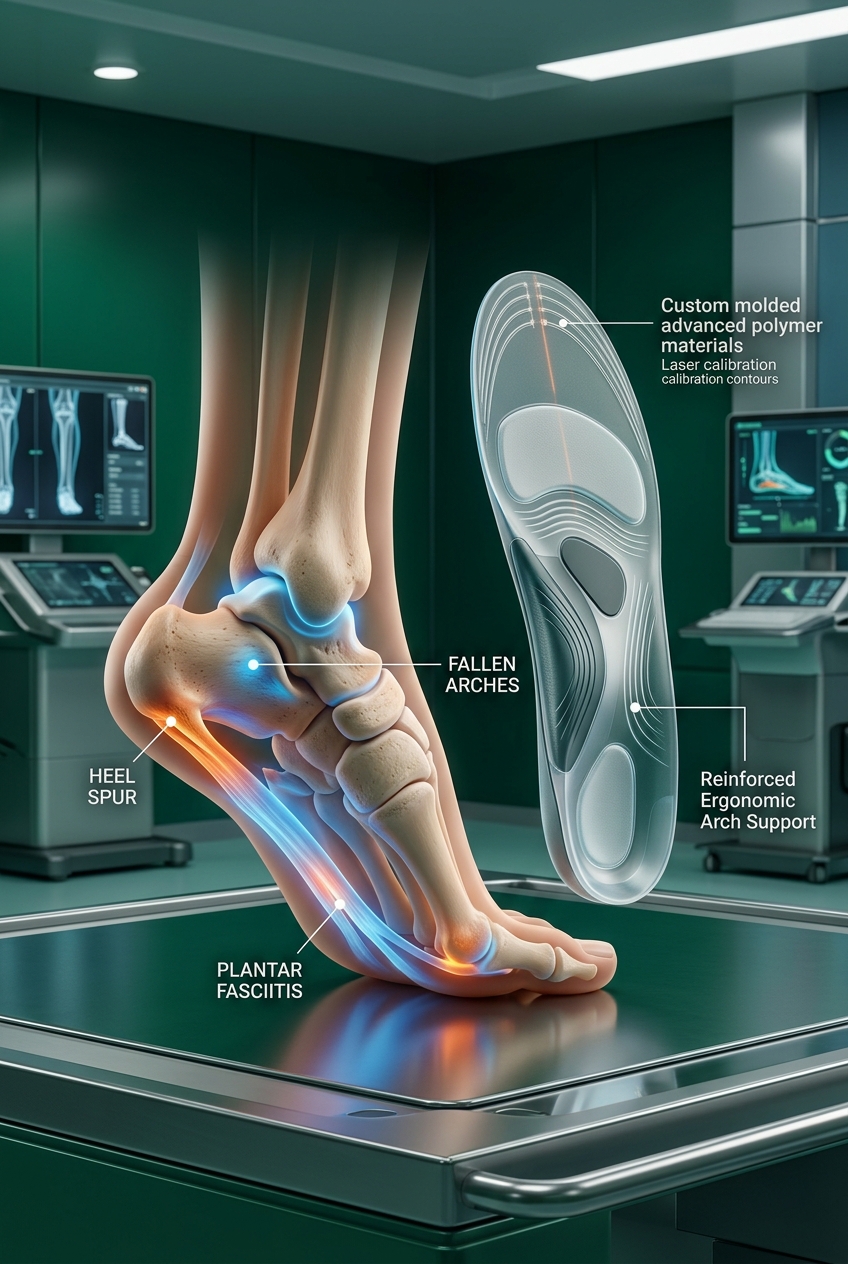
Plantar Fasciitis is an acute or degenerative inflammatory condition affecting the thick band of fibrous tissue (the plantar fascia) that spans the plantar aspect of the foot from the calcaneus to the proximal phalanges. Characterized historically as Policeman’s Heel, patients experience excruciating bottom of foot pain and severe morning heel pain during the very first steps out of bed. As the foot rests at night in plantarflexion, the inflamed fascia contracts; sudden weight-bearing induces repetitive micro-tears at the calcaneal enthesis, resulting in sharp heel spur pain and severe foot arch strain.
Ortho Plus Specialized Clinical Solution: Precision 3D-scanned biomechanical foot orthotics featuring deep heel cups for calcaneal fat pad containment, rigid medial longitudinal arch contours to unload tensile strain, and night dorsiflexion stretching splints that preserve tissue elongation overnight.
Arch Structural
Target Keywords:
Pes Planus
Flat Feet
Fallen Arches
Flatfoot
Low Arches
Pronated Feet
Hyperpronation
Pes Planus, commonly referred to as Flat Feet or Fallen Arches, is a structural foot deformity wherein the medial longitudinal arch collapses completely or touches the ground during weight-bearing stance. Individuals exhibiting low arches or pronated feet experience chronic internal tibial rotation and excessive hyperpronation. This kinetic disruption strains the plantar fascia, posterior tibial tendon, and medial knee compartments, precipitating rapid muscular fatigue, shin splints, and secondary lower back aches during prolonged standing.
Ortho Plus Specialized Clinical Solution: Functional semi-rigid polypropylene or carbon-composite orthotic insoles engineered with calibrated medial arch contouring, rearfoot varus wedge posting to neutralize calcaneal eversion, and reinforced lateral borders.
Arch Structural
Target Keywords:
Pes Cavus
High Arches
High Arched Feet
Rigid Foot
Supinated Foot
Claw Foot Arch
Hollow Foot
Pes Cavus represents the opposite structural anomaly of flatfoot, distinguished by abnormally exaggerated high arches that fail to flatten during dynamic ground impact. Frequently referred to as a hollow foot or rigid foot, a supinated foot exhibits dramatically reduced surface contact area, concentrating intense ground-reactive shock strictly upon the posterior heel and anterior metatarsal heads. Over time, patients develop digital retraction known as claw foot arch, lateral ankle instability, recurrent ankle sprains, and stress fractures.
Ortho Plus Specialized Clinical Solution: High-fill shock-absorbing multi-layer orthotics (combining EVA and Poron) designed to fill the high arch void completely, increasing plantar surface distribution and providing lateral forefoot wedge posting to counteract excessive supination.
Forefoot
Target Keywords:
Metatarsalgia
Ball of Foot Pain
Stone Bruise
Forefoot Pain
Metatarsal Pain
Pain Under Toe Joint
Metatarsalgia is a common overuse injury marked by acute inflammation and forefoot pain localized at the heads of the metatarsal bones. Patients frequently describe the sensation as a sharp ball of foot pain or like stepping continuously on a hard pebble or stone bruise. Exacerbated by prolonged barefoot walking on tile floors, tight footwear, high-impact running, or hammer toe deformities, metatarsal pain causes burning tenderness and throbbing pain under toe joint regions during the push-off phase of gait.
Ortho Plus Specialized Clinical Solution: Custom orthotics incorporating a teardrop-shaped metatarsal pad positioned just proximal to the 2nd, 3rd, and 4th metatarsal heads to elevate and spread the transverse arch, accompanied by forefoot Poron cushioning and rocker-bottom footwear modifications.
Toes & Forefoot
Target Keywords:
Bunions
Hallux Valgus
Big Toe Joint Bump
Crooked Big Toe
Bunion Deformity
Toe Deviation
Hallux Valgus, universally recognized as Bunions, is a progressive progressive joint deformity where the first metatarsal shifts inward (varus) and the hallux deviates outward toward the second toe. This pronounced toe deviation produces a visible, erythematous, and painful big toe joint bump along the medial foot border. In severe cases of a crooked big toe, the hallux may underlap or overlap neighboring digits, causing bursitis, severe friction with shoes, and secondary crossover deformities.
Ortho Plus Specialized Clinical Solution: Dynamic hallux valgus corrective night splints, medical-grade gel toe separators, wide-toe-box orthopedic shoes, and custom insoles with first metatarsal head cutouts to eliminate medial shearing pressure and arrest deformity progression.
Posterior Heel
Target Keywords:
Achilles Tendonitis
Achilles Tendinopathy
Heel Cord Pain
Back of Heel Inflammation
Sore Achilles
Ankles Tendon Pain
The Achilles tendon is the thickest and strongest tendon in the human musculoskeletal system, connecting the gastrocnemius and soleus calf muscles to the posterior calcaneus. Achilles Tendonitis (or chronic Achilles Tendinopathy) presents with acute heel cord pain, morning stiffness, and visible back of heel inflammation. Driven by tight calf muscles, unaccustomed athletic intensity, or sudden heel-drop mechanics, patients suffer from a persistently sore Achilles and incapacitating ankles tendon pain during stair climbing and uphill walking.
Ortho Plus Specialized Clinical Solution: Bilateral viscoelastic silicone heel lifts (6mm to 10mm) to physically shorten the gastroc-soleus complex and eliminate tensile traction, paired with custom orthotic rearfoot stabilization and articulated AFO splints for severe cases.
Heel Bone
Target Keywords:
Heel Spurs
Calcaneal Spurs
Bone Spur on Heel
Heel Bone Growth
Rearfoot Bone Spur
A Heel Spur (scientifically termed a calcaneal spur) is a pointed calcium osteophyte or bone spur on heel structures that develops on the undersurface or posterior aspect of the calcaneus. Resulting from months or years of repetitive traction from the plantar fascia or Achilles tendon, this abnormal heel bone growth projects forward. While the spur itself is bone, surrounding soft tissue becomes intensely inflamed, making any direct heel strike excruciating without specialized rearfoot bone spur cushioning.
Ortho Plus Specialized Clinical Solution: Custom 3D orthotics designed with horseshoe-shaped or donut-shaped heel cutouts filled with ultra-soft Poron/medical silicone, offloading direct vertical ground pressure away from the calcaneal spur.
Nerve & Forefoot
Target Keywords:
Morton’s Neuroma
Intermetatarsal Neuroma
Pinched Nerve in Foot
Sworn Nerve Foot
Burning Toe Pain
Numbness in Toes
Morton’s Neuroma, or an intermetatarsal neuroma, is a painful thickening and perineural fibrosis of the digital nerve passing beneath the deep transverse metatarsal ligament, most commonly between the third and fourth toes. When footwear squeezes the metatarsal bones together, this pinched nerve in foot structures provokes radiating electric shocks, persistent burning toe pain, cramping, and distal numbness in toes. Patients often feel compelled to remove their shoes and massage the ball of their foot to decompress the swollen plantar digital nerve.
Ortho Plus Specialized Clinical Solution: Neuroma orthotics featuring a dome-shaped retro-metatarsal pad that physically separates and widens the intermetatarsal space, instantly releasing pressure from the compressed nerve bundle.
Midfoot Joints
Target Keywords:
Midfoot Arthritis
Foot Osteoarthritis
Midfoot Degenerative Joint Disease (DJD)
Foot Joint Wear and Tear
Top of Foot Arthritis
Midfoot Pain
The midfoot tarsometatarsal (Lisfranc) complex endures immense compressive torque during ambulation. Midfoot Arthritis, also classified as Foot Osteoarthritis or Midfoot Degenerative Joint Disease (DJD), occurs when protective articular cartilage wears away due to aging, trauma, or severe flatfoot deformity. As foot joint wear and tear accelerates, prominent dorsal osteophytes form, creating bony lumps that hurt when laced into shoes, generating severe top of foot arthritis and persistent, deep midfoot pain on standing.
Ortho Plus Specialized Clinical Solution: Full-contact rigid carbon-fiber arch supports paired with full-length stiff rocker-sole footwear modifications that eliminate sagittal-plane midfoot joint bending during terminal stance.
Tendon & Ankle
Target Keywords:
Posterior Tibial Tendon Dysfunction (PTTD)
Adult-Acquired Flatfoot
Inside Ankle Pain
Fallen Arch Tendonitis
Tibialis Posterior Syndrome
The tibialis posterior tendon is the premier dynamic stabilizer of the medial foot arch. When this tendon becomes inflamed, stretched, or torn, Posterior Tibial Tendon Dysfunction (PTTD) develops, leading to progressive Adult-Acquired Flatfoot deformity. Patients present with debilitating inside ankle pain along the medial malleolus, swelling, and fallen arch tendonitis. Without prompt orthotic bracing, the arch collapses completely, the heel rolls into extreme valgus, and the patient loses the ability to perform a single-leg heel raise.
Ortho Plus Specialized Clinical Solution: In Stage 1 and 2, deep-heel-cup UCBL orthotics or custom leather-laced gauntlets (Arizona AFO); in advanced rigid stages, articulated or solid ankle-foot orthoses (AFOs) to control subtalar and midtarsal hyper-pronation.
Lower Leg
Target Keywords:
Shin Splints
Medial Tibial Stress Syndrome (MTSS)
Shin Bone Pain
Exercise-Induced Leg Pain
Calf and Shin Soreness
Known clinically as Medial Tibial Stress Syndrome (MTSS), Shin Splints involve exercise-induced periostitis along the posteromedial border of the tibia. Common among runners, military recruits, and athletes who rapidly ramp up training volume on hard surfaces, it generates intense shin bone pain and calf and shin soreness. Biomechanically driven by overpronation where excessive foot collapse exerts continuous traction on the soleus and tibialis posterior muscle attachments, this exercise-induced leg pain can advance to tibial stress fractures if ignored.
Ortho Plus Specialized Clinical Solution: Biomechanical semi-flexible orthotics with medial longitudinal arch posting to eliminate excessive pronatory velocity, paired with shock-absorbing visco-elastic heel cushions and graded calf compression sleeves.
Lesser Toes
Target Keywords:
Hammer Toes
Claw Toes
Mallet Toes
Crooked Toes
Curled Toes
Bent Toe Joints
Muscle-tendon imbalances between the intrinsic foot muscles and long extrinsic digital flexors/extensors trigger lesser toe deformities. In Hammer Toes, the proximal interphalangeal (PIP) joint flexes sharply while the distal joint extends. In Claw Toes, both interphalangeal joints curl downward into bent toe joints, and in Mallet Toes, only the distal tip curls down. These crooked toes and curled toes rub relentlessly against shoe uppers, forming excruciating dorsal corns and predisposing patients to ulceration.
Ortho Plus Specialized Clinical Solution: Silicone digital crest pads that elevate the distal phalanges, custom orthotics with a supportive metatarsal crest to realign toe extension, and extra-depth custom orthopedic footwear with stretchable soft neoprene vamp uppers.
Big Toe Base
Target Keywords:
Sesamoiditis
Ball of Big Toe Pain
Sesamoid Bone Inflammation
Dancer's Foot Pain
Under Big Toe Pain
Beneath the first metatarsal head lie two tiny pea-shaped bones embedded within the flexor hallucis brevis tendon—the sesamoid bones. Sesamoiditis is an inflammatory or stress fracture disorder causing intense ball of big toe pain. Common among dancers, sprinters, and basketball players who pivot on the forefoot, this condition is frequently labeled dancer's foot pain. Swelling, localized erythema, and deep under big toe pain intensify whenever the big toe extends during walking, running, or stair climbing.
Ortho Plus Specialized Clinical Solution: Custom foot orthoses featuring a dancer’s pad modification—an offloading cutout under the first metatarsophalangeal joint that transfers weight entirely to the 2nd through 5th metatarsal shafts, paired with a carbon-fiber rigid Morton’s extension.
Skin & Pressure
Target Keywords:
Corns
Calluses
Hyperkeratosis
Hard Skin on Foot
Thick Foot Skin
Painful Foot Knots
Friction Lesions
Corns and Calluses are localized accumulations of dead keratinized skin cells—a clinical defense mechanism termed hyperkeratosis triggered by persistent friction and abnormal shear stress. While calluses produce broad patches of thick foot skin on the heel and ball of the foot, corns develop a conical, inward-pointing hard central core. These painful foot knots and friction lesions press directly into deep sensory nerve endings, making every step intensely painful, especially in elderly or diabetic individuals.
Ortho Plus Specialized Clinical Solution: Multi-density total contact orthotic insoles with micro-cellular Plastazote top covers that eliminate shear friction, accompanied by localized aperture cutouts and wide orthopedic footwear.
Structural Biomechanics
Target Keywords:
Limb Length Discrepancy (LLD)
Leg Length Unevenness
Short Leg Syndrome
Unequal Leg Length
One Leg Shorter
Pelvic Tilt Leg Issues
Limb Length Discrepancy (LLD) arises when one lower extremity is noticeably shorter than the other due to post-fracture malunion, congenital hip dysplasia, childhood infection, polio, or knee/hip arthroplasty. Often dubbed short leg syndrome, having unequal leg length or one leg shorter forces the pelvis to sag on the shorter side. This chronic lateral pelvic tilt leg issues provoke compensatory functional scoliosis, sacroiliac joint dysfunction, asymmetric knee wear, and persistent unilateral lumbar spine pain.
Ortho Plus Specialized Clinical Solution: Full-foot custom internal orthotic heel-to-toe shoe lifts (up to 10mm–12mm inside footwear) or external full-sole shoe buildups (for discrepancies exceeding 12mm) to achieve complete pelvic horizon symmetry.
Diabetic Critical
Target Keywords:
Diabetic Foot Ulcers
Diabetic Neuropathy
Diabetic Nerve Damage
Numb Feet
Diabetic Foot Sores
Poor Circulation Foot Wounds
Diabetes mellitus damages peripheral nerves over time, resulting in sensory Diabetic Neuropathy. When patients develop completely numb feet and lose the "gift of pain," repetitive pressure from ill-fitting shoes or walking triggers micro-trauma without warning. Compounded by peripheral vascular disease, minor friction spots deteriorate into open diabetic foot ulcers, infected diabetic foot sores, and non-healing poor circulation foot wounds that represent the leading cause of non-traumatic lower extremity amputations worldwide.
Ortho Plus Specialized Clinical Solution: Multi-density total contact diabetic insoles fabricated with thermoformable Plastazote top covers (zero-shear surface), seamless extra-depth diabetic shoes with rigid rocker soles, and specialized offloading boots (CAM walkers) for active ulcers.
Diabetic Emergency
Target Keywords:
Charcot Foot
Charcot Arthropathy
Diabetic Foot Collapse
Swollen Diabetic Foot
Neuropathic Joint Destruction
Charcot Foot, or neuropathic Charcot Arthropathy, is a severe, limb-threatening complication of dense peripheral neuropathy. Characterized by profound neurovascular hyper-perfusion, the tarsal bones demineralize, fracture, and dislocate under normal body weight without the patient sensing acute pain. The patient presents with an acutely warm, red, and swollen diabetic foot. If weight-bearing continues, total diabetic foot collapse ensues, creating a classic "rocker-bottom" deformity prone to devastating bone-penetrating ulcers.
Ortho Plus Specialized Clinical Solution: Immediate total contact casting (TCC) in the acute inflammatory stage, transitioning to a custom-molded CROW (Charcot Restraint Orthotic Walker) bi-valved AFO boot with full rocker sole to permanently protect the collapsed midfoot arch.
Congenital Structural
Target Keywords:
Tarsal Coalition
Fused Foot Bones
Rigid Flatfoot
Congenital Foot Bone Fusion
Painful Stiff Flatfoot
Tarsal Coalition is an abnormal congenital bridging between two or more tarsal bones—most frequently talocalcaneal or calcaneonavicular coalitions. The connection may be osseous (bone), cartilaginous, or fibrous. As children reach adolescence (ages 10 to 16) and these bridges ossify, subtalar joint motion is arrested, generating a severely painful stiff flatfoot. Characterized by rigid flatfoot and peroneal muscle spasm, the foot cannot invert or adapt to uneven terrain.
Ortho Plus Specialized Clinical Solution: Rigid polypropylene functional foot orthotics designed to completely lock and stabilize the subtalar joint, or custom high-top molded AFO gauntlets that eliminate all painful hindfoot inversion-eversion torsion during walking.
Posterior Heel
Target Keywords:
Haglund’s Deformity
Pump Bump
Retrocalcaneal Bursitis
Back of Heel Bump
Achilles Bone Spur
Haglund’s Deformity is a bony enlargement on the posterosuperior prominence of the calcaneus, colloquially termed a pump bump due to its prevalence among women wearing rigid-backed high heels or pumps. When this bony prominence rubs against rigid shoe counters, secondary retrocalcaneal bursitis and insertional Achilles tendonitis develop. The resulting inflamed, tender back of heel bump makes wearing closed shoes agonizingly painful.
Ortho Plus Specialized Clinical Solution: Custom orthotics with elevated heel cups and soft posterior cutouts, silicone heel sleeve pads that create a frictionless barrier over the bump, and open-back or custom-molded orthopedic shoes.
Neuromuscular
Target Keywords:
Drop Foot
Foot Drop
Flaccid Foot
Weak Ankle
Dragging Foot
Peroneal Nerve Injury
Slap Foot
Drop Foot (or Foot Drop) is a neuromuscular weakness or flaccid paralysis of the anterior tibialis and foot dorsiflexor muscles, stemming from deep peroneal nerve injury, stroke, sciatica, lumbar radiculopathy (L4-L5), or multiple sclerosis. Unable to lift the front of the foot during the swing phase of gait, patients compensate by raising the knee excessively high ("steppage gait") to prevent tripping over a dragging foot. Upon landing, the foot strikes the ground with an uncontrolled, audible slap foot sound.
Ortho Plus Specialized Clinical Solution: Ultra-lightweight carbon-fiber dynamic Ankle-Foot Orthoses (AFOs) or custom-molded polypropylene posterior leaf spring splints that hold the ankle securely at a neutral 90 degrees, restoring fluid heel strike.
Pediatric Deformity
Target Keywords:
Clubfoot
Talipes Equinovarus
Inward Turned Foot
Twisted Newborn Foot
Congenital Foot Deformity
Congenital Talipes Equinovarus (CTEV), universally known as Clubfoot, is a major congenital foot deformity present at birth in approximately 1 in 1,000 newborns. The child's foot presents with a severe inward turned foot and downward equinus contracture (CAVE: Cavus, Adductus, Varus, Equinus), resembling the head of a golf club. If not treated immediately with the Ponseti method, the child is forced to walk on the outside or top of their twisted newborn foot, resulting in crippling lifelong disability.
Ortho Plus Specialized Clinical Solution: Following gentle serial Ponseti plaster casting and percutaneous Achilles tenotomy, children must wear Foot Abduction Orthoses (Ponseti Boots and Bar or Mitchell Splints) set at 60-70 degrees external rotation to permanently prevent relapses.
Bone Necrosis
Target Keywords:
Freiberg’s Disease
Freiberg’s Infraction
Dead Bone in Foot
Second Metatarsal Avascular Necrosis
Forefoot Bone Death
Freiberg’s Disease (or Freiberg’s Infraction) is a form of osteochondrosis and avascular necrosis affecting the head of the second (or occasionally third) metatarsal bone. Temporary disruption of blood circulation causes localized forefoot bone death and collapse of the articular joint surface, creating a colloquial perception of a dead bone in foot structures. Most frequently diagnosed in active adolescent females and athletes, it manifests as dull throbbing forefoot pain, dorsal edema, and progressive joint stiffness.
Ortho Plus Specialized Clinical Solution: Custom offloading orthotics with a deep metatarsal pocket that suspends the affected second metatarsal head without ground contact, combined with a rigid carbon-fiber sole plate and anterior rocker sole.
Pediatric Heel
Target Keywords:
Sever’s Disease
Calcaneal Apophysitis
Child Heel Pain
Growing Pains Heel
Pediatric Heel Inflammation
Sever’s Disease, known formally as Calcaneal Apophysitis, is the single most prevalent cause of child heel pain in growing kids between the ages of 8 and 14. During the adolescent growth spurt, bones lengthen faster than muscles; the tight Achilles tendon exerts repetitive traction on the un-fused cartilaginous growth plate of the heel. Mistaken commonly for general growing pains heel issues, this painful pediatric heel inflammation flares during soccer, cricket, running, and jumping, causing children to limp or walk exclusively on their tiptoes.
Ortho Plus Specialized Clinical Solution: Viscoelastic shock-absorbing silicone heel cups with medial arch stabilizers and soft heel-elevating wedges (10mm) that instantly slacken the Achilles tendon tension and insulate the inflamed growth plate from ground shock.
Autoimmune & Systemic
Target Keywords:
Rheumatoid Arthritis of the Foot
Inflammatory Foot Arthritis
Autoimmune Foot Pain
Rheumatoid Foot Deformity
Swollen Foot Joints
Over 90% of individuals diagnosed with rheumatoid arthritis experience bilateral foot and ankle symptoms. Rheumatoid Arthritis of the Foot is a chronic systemic inflammatory foot arthritis where autoantibodies attack the synovial lining of joints. Resulting in warm, exquisitely swollen foot joints and unrelenting autoimmune foot pain, the disease erodes bone and collateral ligaments. This produces complex rheumatoid foot deformity including severe bunions, hallux valgus, clawing of all lesser toes, forefoot fat-pad atrophy, and complete midfoot arch collapse.
Ortho Plus Specialized Clinical Solution: Ultra-accommodative custom orthotics featuring high-density dual-layer Plastazote with Poron shock beds to cushion dislocated metatarsal heads, matched with custom extra-depth, wide-toe-box therapeutic footwear and rocker soles.
پاؤں اور ٹخنے کی 24 عام بیماریاں، بگاڑ اور درد: مکمل رہنمائی اور آرتھوٹک علاج
انسانی پاؤں چلنے، دوڑنے اور جسمانی وزن سنبھالنے کے لیے 26 ہڈیوں، 33 جوڑوں اور 100 سے زائد پٹھوں اور رگوں پر مشتمل ایک انتہائی حساس قدرتی شاہکار ہے۔ جب پاؤں کی قدرتی ساخت میں خرابی، ضرورت سے زیادہ دباؤ یا اعصابی کمزوری واقع ہو جائے تو شدید درد اور چلنے پھرنے میں دشواری پیدا ہو جاتی ہے۔
آرتھو پلس کلینک کراچی کی جانب سے پاؤں اور ٹخنے کی 24 اہم ترین بیماریوں کی مکمل تفصیل، وجوہات، علامات اور ان کا جدید کسٹم میڈیکل انسولز اور آرتھوٹک بریسز کے ذریعے علاج پیشِ خدمت ہے۔
1. پلانٹر فیشائٹس (Plantar Fasciitis / ایڑی کا درد)
پلانٹر فیشائٹس پاؤں کے تلوے اور ایڑی کے شدید درد کا نام ہے جسے عام زبان میں ایڑی کی ہڈی بڑھنا یا پولیس مینز ہیل بھی کہا جاتا ہے۔ مریض کو صبح بستر سے پہلا قدم رکھتے ہی ایڑی میں تیز سوئی چبھنے جیسا درد محسوس ہوتا ہے۔ رات بھر آرام کے دوران کھچاؤ پیدا ہونے والا ٹشو صبح کے پہلے قدم پر شدید کھنچتا ہے۔
آرتھو پلس کلینکل حل و پروسیجر: کسٹم 3D میڈیکل انسولز جس میں ڈیپ ہیل کپ اور محراب (Arch) کا مکمل سہارا دیا جاتا ہے، اور رات کو پہننے والی اسپلنٹ جو ٹشو کو سکڑنے سے روکتی ہے۔
2. پیس پلینس / فلیٹ فیٹ (Pes Planus / چپٹے پاؤں)
فلیٹ فیٹ یا چپٹے پاؤں میں تلوے کی قدرتی محراب ختم ہو جاتی ہے اور پاؤں زمین پر بالکل سیدھا لگنے لگتا ہے۔ اس کی وجہ سے چلتے وقت پاؤں اندر کی طرف جھکتا ہے (Pronation)، جس سے ٹخنے، پنڈلی اور گھٹنے پر مسلسل کھچاؤ رہتا ہے اور انسان جلدی تھک جاتا ہے۔
آرتھو پلس کلینکل حل و پروسیجر: پاؤں کے ناپ کے مطابق تیار کردہ میڈیکل آرچ سپورٹ انسولز جو پاؤں کے اندرونی بوجھ کو متوازن کرتے ہیں اور گھٹنوں کے بگاڑ کو روکتے ہیں۔
3. پیس کیوس / ہائی آرچ (Pes Cavus / اونچی محراب والے پاؤں)
پیس کیوس میں پاؤں کی محراب عام حالت سے بہت زیادہ اونچی اور سخت ہوتی ہے۔ زمین پر پاؤں کا صرف اگلا حصہ اور ایڑی لگتی ہے، جس سے جھٹکے جذب کرنے کی صلاحیت ختم ہو جاتی ہے اور ٹخنہ مڑنے اور موچ آنے کے خطرات بڑھ جاتے ہیں۔
آرتھو پلس کلینکل حل و پروسیجر: ہائی آرچ کو بھرنے والے نرم اور شاک ابزاربنگ کسٹم انسولز جو پورے تلوے پر بوجھ برابر تقسیم کرتے ہیں۔
4. میٹاٹارسلجیا (Metatarsalgia / پاؤں کے اگلے پنجے کا درد)
پاؤں کے اگلے حصے یعنی انگلیوں کے نیچے کی ہڈیوں (Ball of Foot) پر شدید جلن اور درد کو میٹاٹارسلجیا کہتے ہیں۔ مریض کو ایسا لگتا ہے جیسے جوتے کے اندر کوئی کنکر یا پتھر چبھ رہا ہو۔ سخت فرش پر ننگے پاؤں چلنے یا تنگ جوتے پہننے سے یہ تکلیف بڑھ جاتی ہے۔
آرتھو پلس کلینکل حل و پروسیجر: کسٹم انسول میں خاص میٹاٹارسل پیڈ (Metatarsal Pad) جو اگلے پنجے کا بوجھ ہٹا کر درد ختم کرتا ہے۔
5. بنینز / ہالکس ویلگس (Bunions / پاؤں کے انگوٹھے کا ٹیڑھا پن)
پاؤں کے بڑے انگوٹھے کے جوڑ کی ہڈی کا باہر کی طرف نکل آنا اور انگوٹھے کا باقی انگلیوں کی طرف مڑ جانا بنین (Bunion) کہلاتا ہے۔ اس ابھار پر جوتے کی رگڑ سے شدید سوجن، لالی اور چلنے میں شدید تکلیف ہوتی ہے۔
آرتھو پلس کلینکل حل و پروسیجر: سیلیکون ٹو سیپریٹرز، بنین نائٹ اسپلنٹ اور چوڑے پنجے والے خاص کسٹم آرتھوپیڈک جوتے۔
6. اکیلیس ٹینڈونائٹس (Achilles Tendonitis / ایڑی کے پچھلے پٹھے کی سوجن)
ایڑی کے پچھلے موٹے پٹھے میں کھچاؤ اور سوزش کو اکیلیس ٹینڈونائٹس کہا جاتا ہے۔ سیڑھیاں چڑھنے یا زیادہ چلنے سے ایڑی کے پچھلے حصے میں جلن اور شدید کھنچاؤ پیدا ہوتا ہے۔
آرتھو پلس کلینکل حل و پروسیجر: سیلیکون ہیل کشنز اور ہیل لفٹس جو پٹھے کے کھچاؤ کو فوری کم کرتے ہیں۔
7. ہیل اسپر (Heel Spurs / ایڑی کی ہڈی کا اگاؤ)
ایڑی کے نیچے کیلشیم جمع ہونے سے نوکیلی ہڈی نما ابھار بن جاتا ہے جسے ہیل اسپر کہتے ہیں۔ اس پر وزن پڑنے سے ٹشوز میں شدید چبھن ہوتی ہے۔
آرتھو پلس کلینکل حل و پروسیجر: کٹ آؤٹ والے خاص شاک ابزاربنگ ہیل کپ اور انسولز جو ہڈی کو بغیر چھوئے بوجھ اردگرد منتقل کرتے ہیں۔
8. مورٹنز نیوروما (Morton’s Neuroma / پاؤں کی رگ کا دبنا)
تیسری اور چوتھی انگلی کے درمیان نس (Nerve) کے دب جانے سے جلن، کرنٹ لگنے کا احساس اور انگلیاں سن ہونے لگتی ہیں۔ تنگ جوتے پہننے سے یہ تکلیف شدید ہو جاتی ہے۔
آرتھو پلس کلینکل حل و پروسیجر: کسٹم انسول نیوروما پیڈ جو ہڈیوں کو پھیلا کر رگ سے دباؤ ختم کرتا ہے۔
9. مڈفٹ آرتھرائٹس (Midfoot Arthritis / پاؤں کے درمیانی جوڑوں کی گٹھیا)
پاؤں کے درمیانی جوڑوں میں گٹھیا اور گھساؤ سے پاؤں کے اوپری حصے پر سخت ہڈی ابھر آتی ہے، جس پر تسمے یا جوتا لگنے سے شدید درد ہوتا ہے۔
آرتھو پلس کلینکل حل و پروسیجر: سخت کاربن فائبر آرچ سپورٹ اور راکر سول موڈیفکیشن۔
10. پوسٹیریئر ٹیبیل ٹینڈن خرابی (PTTD / اندرونی ٹخنے اور تلوے کی محراب کا بیٹھ جانا)
ٹخنے کے اندرونی پٹھے کے کمزور ہونے سے جوان افراد میں بھی پاؤں کی محراب گر جاتی ہے، جس سے اندرونی ٹخنے پر مسلسل سوجن اور شدید درد ہوتا ہے۔
آرتھو پلس کلینکل حل و پروسیجر: یو سی بی ایل (UCBL) اور ایریزونا بریس جو ٹخنے کو مکمل محفوظ بناتے ہیں۔
11. شن اسپلنٹس (Shin Splints / پنڈلی کی ہڈی کا درد)
دوڑنے اور سخت سطح پر کھیلنے سے پنڈلی کی ہڈی کے پردے پر سوزش ہو جاتی ہے۔ پاؤں کے غیر متوازن جھکاؤ کی وجہ سے یہ درد ہوتا ہے۔
آرتھو پلس کلینکل حل و پروسیجر: فلیٹ فیٹ درست کرنے والے بائیو مکینیکل انسولز اور شاک ابزاربنگ فٹ ویئر۔
12. ہیمر ٹوز / مڑی ہوئی انگلیاں (Hammer Toes / Claw Toes)
انگلیوں کے جوڑوں کا ہتھوڑے کی طرح مڑ جانا جس سے جوتے کی اوپری سطح پر گھس کر سخت گھٹے (Corns) بن جاتے ہیں۔
آرتھو پلس کلینکل حل و پروسیجر: سیلیکون ٹو پروٹیکٹرز، ٹو اسٹریٹنر اسپلنٹس اور ایکسٹرا ڈیپتھ جوتے۔
13. سیسامائیڈائٹس (Sesamoiditis / بڑے انگوٹھے کے نیچے کا درد)
انگوٹھے کے نیچے موجود دو چھوٹی بیج نما ہڈیوں میں رقص، دوڑ یا زیادہ چلنے سے پیدا ہونے والی تکلیف دہ سوجن۔
آرتھو پلس کلینکل حل و پروسیجر: ڈانسرز پیڈ اور کسٹم افلوڈنگ انسولز۔
14. گھٹے اور چھالے (Corns and Calluses / پاؤں کی سخت جلد)
پاؤں کی جلد پر مستقل دباؤ اور رگڑ سے سخت چھالے اور گانٹھیں بن جاتی ہیں جو چلتے وقت شدید چبھتی ہیں۔
آرتھو پلس کلینکل حل و پروسیجر: نرم پلاسٹرزوٹ انسولز جو پاؤں سے ہر قسم کی رگڑ کو ختم کرتے ہیں۔
15. ٹانگوں کی لمبائی میں فرق (Limb Length Discrepancy / ایک ٹانگ چھوٹی ہونا)
ایک ٹانگ چھوٹی ہونے کی وجہ سے کولہے ٹیڑھے ہو جاتے ہیں، کمر میں مستقل درد رہتا ہے اور انسان لنگڑا کر چلتا ہے۔
آرتھو پلس کلینکل حل و پروسیجر: جوتے کے اندر یا باہر لگایا جانے والا کسٹم ہیل اینڈ سول لفٹ (Shoe Raise)۔
16. شوگر کے زخم اور سن پن (Diabetic Foot Ulcers / Neuropathy)
شوگر کے مریضوں کے پاؤں سن ہو جاتے ہیں اور چھوٹے زخم بگڑ کر گہرے ناسور بن جاتے ہیں جو کٹاؤ (Amputation) کا سبب بن سکتے ہیں۔
آرتھو پلس کلینکل حل و پروسیجر: ملٹی ڈینسٹی کسٹم ڈائیبیٹک انسولز اور بغیر سلائی والے چوڑے شوگر اسپیشل جوتے۔
17. چارکوٹ فٹ (Charcot Foot / شوگر کی وجہ سے پاؤں کی ہڈیوں کا بیٹھ جانا)
شوگر میں شدید اعصابی کمزوری کے بعد پاؤں کی ہڈیاں ٹوٹ کر پاؤں الٹی کشتی (Rocker Bottom) کی شکل میں بیٹھ جاتا ہے۔
آرتھو پلس کلینکل حل و پروسیجر: کرو بوٹ (CROW Boot) اور مکمل بوجھ ہٹانے والا کسٹم واکر۔
18. ٹارسل کولیشن (Tarsal Coalition / پاؤں کی ہڈیوں کا آپس میں جڑ جانا)
پیدائشی طور پر پاؤں کی دو یا زائد ہڈیاں جڑ جانے سے پاؤں بالکل سخت اور غیر لچکدار ہو جاتا ہے اور پاؤں موڑنا ناممکن ہو جاتا ہے۔
آرتھو پلس کلینکل حل و پروسیجر: ریجڈ کسٹم آرچ سپورٹ اور حرکت کو محفوظ بنانے والے اسپلنٹس۔
19. ہیگلنڈ ڈیفارمیٹی (Haglund’s Deformity / ایڑی کے پچھلے حصے کا ابھار)
ایڑی کے پچھلے اوپری حصے پر ہڈی کا ابھار جو سخت جوتے رگڑنے سے سوج کر سرخ ہو جاتا ہے اور بند جوتا پہننا عذاب بن جاتا ہے۔
آرتھو پلس کلینکل حل و پروسیجر: سیلیکون ہیل پیڈ اور پچھلے حصے سے کٹ آؤٹ والے کسٹم جوتے۔
20. ڈراپ فٹ (Drop Foot / پاؤں کا لٹک جانا)
فالج یا پیرونیل نس دبنے سے پاؤں کا پنجہ اوپر نہیں اٹھتا اور زمین پر گھسٹتا ہے جس سے مریض بار بار گرنے لگتا ہے۔
آرتھو پلس کلینکل حل و پروسیجر: کاربن فائبر ڈائنامک اے ایف او (AFO Brace) جو پاؤں کو 90 ڈگری پر اٹھا کر سیدھا چلاتی ہے۔
21. کلب فٹ / ٹیلیپیز ایکوئنوویرس (Clubfoot CTEV / نوزائیدہ بچوں کا مڑا ہوا پاؤں)
بچوں کی پیدائشی بیماری جس میں نومولود کا پاؤں اندر اور نیچے کی طرف مکمل مڑا ہوتا ہے۔
آرتھو پلس کلینکل حل و پروسیجر: پونسیٹی بوٹس اینڈ بار (Ponseti Boots and Bar) جو پاؤں کو دوبارہ مڑنے سے 4 سال تک روکتے ہیں۔
22. فرائیبرگ ڈیزیز (Freiberg’s Disease / پنجے کی ہڈی کی کمزوری)
دوسری انگلی کی ہڈی میں خون کی فراہمی عارضی رک جانے سے ہڈی بیٹھ جاتی ہے اور پنجے میں مستقل سوجن اور درد رہتا ہے۔
آرتھو پلس کلینکل حل و پروسیجر: متاثرہ ہڈی کو زمین کے دباؤ سے مکمل محفوظ کرنے والے آف لوڈنگ انسولز۔
23. سیورز ڈیزیز (Sever’s Disease / بچوں کی ایڑی کا درد)
8 سے 14 سال کے بڑھتے ہوئے بچوں میں ایڑی کی نشوونما پانے والی ہڈی پر پٹھے کے کھچاؤ سے شدید سوجن پیدا ہو جاتی ہے جس سے بچہ لنگڑا کر چلتا ہے۔
آرتھو پلس کلینکل حل و پروسیجر: نرم جیلیٹینس سیلیکون ہیل کپس اور جھٹکا روکنے والے پیڈیاٹرک انسولز۔
24. ریومیٹائڈ آرتھرائٹس (Rheumatoid Arthritis / گٹھیا کی وجہ سے پاؤں کا بگاڑ)
قوتِ مدافعت کی خرابی سے پاؤں کے دونوں اطراف کے جوڑ سوج جاتے ہیں، انگلیاں ٹیڑھی ہو جاتی ہیں اور چلنا ناممکن ہو جاتا ہے۔
آرتھو پلس کلینکل حل و پروسیجر: پلاسٹرزوٹ الٹرا سوفٹ کسٹم انسولز اور وسیع ڈیزائن والے تھراپیوٹک جوتے۔